
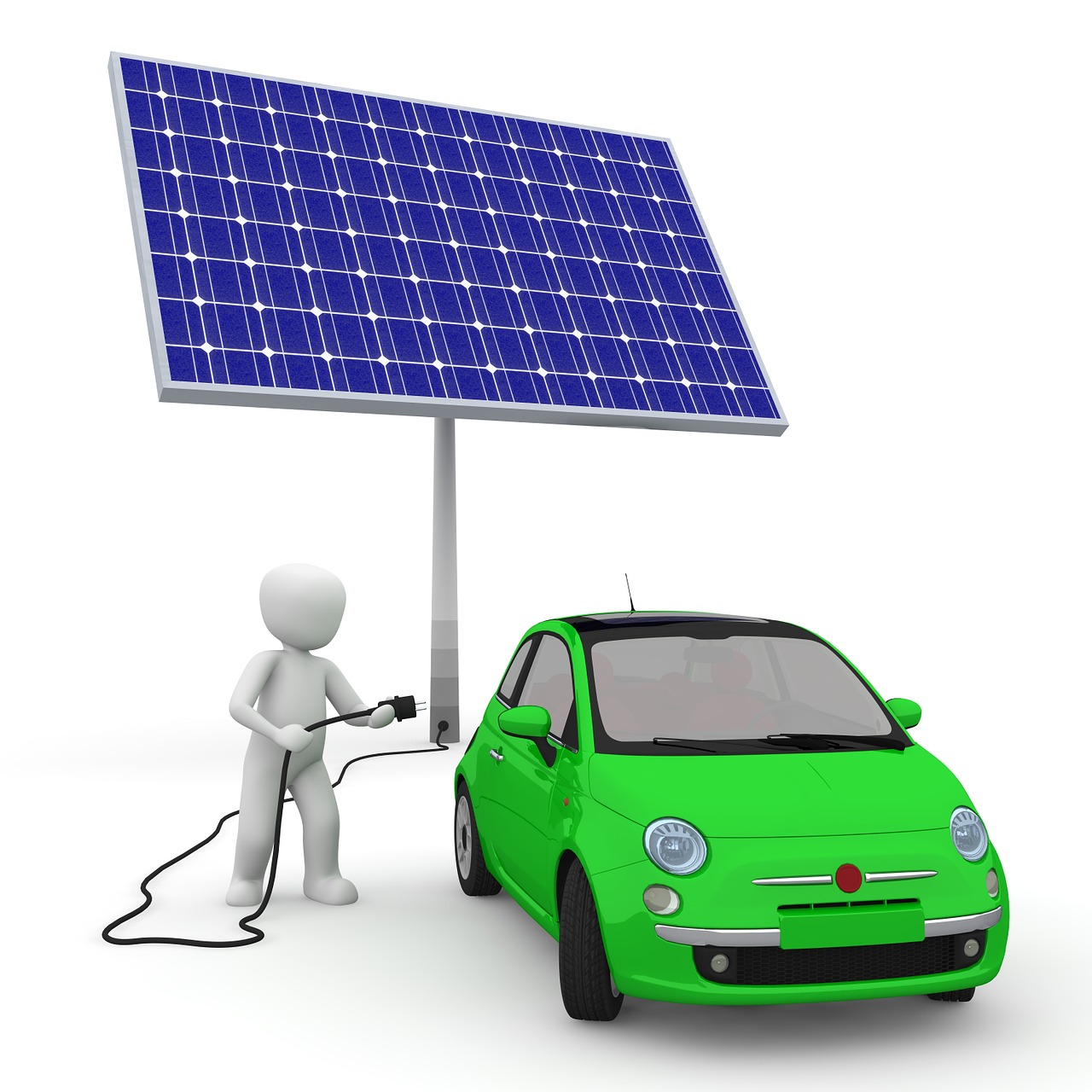
Who already owns one photovoltaic system is certainly less pleased every year that the remuneration for the feed-in is continuously falling and is therefore becoming less and less financially attractive. If you are thinking about buying an electric car, or if you already own one, it can definitely be worth charging it with the solar energy you produce yourself instead of feeding the energy into the grid. The most important questions that arise in this project are to be clarified in this article.
1. What size should the PV system be?
In order to be able to fully charge the electric car, the PV system should not be too small. Plants between 5 and 20 kWp (kilowatt peak = peak value that a PV system delivers under ideal irradiation conditions) are ideal if the solar power is to be used both for household appliances and for charging electric cars. Typical sizes for PV systems on single-family homes deliver between 4 and 10kWp, and thus provide an annual yield of between 4000 and 10,000 kWh.
For technical reasons, 1.4 kW is required to charge an electric car. This means that the solar system must also supply at least this electricity. The more household appliances are also operated with solar power, the larger the solar system has to be in order to guarantee the energy for charging the electric car and for operating all consumers.
2. What else is important?
If you already have a PV system, when choosing a charging station you should make sure that it has all the interfaces that are needed to communicate with the solar system. It is advisable to obtain information on this from the provider who provided the system, as many providers recommend certain charging stations.
If you already have an e-car with a charging station and this is to be refueled with solar energy in the future, it is important to take this into account when dimensioning the interface PV system to consider. Since only a few charging stations are designed to communicate with a PV system, it may be necessary to invest in a new charging station.
When it comes to the charging station, you usually have the choice between 11kW and 22kW models. 11kW has the advantage that the proportion of solar power that is loaded into the car is higher. With a 22kW charging station, due to the lower performance of many PV systems, additional electricity is tapped from the grid to charge the e-car. The 22kW charging stations have the advantage that the car battery is fully charged more quickly.
It should also be noted that even with an 11kW charging station, the car cannot be charged faster if it only allows single-phase charging. In this case, the maximum charging power is 3.7kW.
3. Battery storage – yes or no?
An electric car consumes around 15 to 20 kWh per 100 kilometers. Assuming an annual yield of 6000 kWh for the private PV system, this means that it generates an average of more than 16 kWh per day, which is more than sufficient for a typical commuter distance of 20 kilometers.
However, since the sun does not shine every day, the yields are not consistent. This means that on some days the e-car cannot be charged or cannot be fully charged. In order to bridge such bottlenecks, a solar storage advantageous. This ensures that on dark days the e-car can be refueled with previously stored solar power.
However, since additional battery storage is also a major cost factor, it naturally reduces the profitability of the PV system. Whether such a memory is necessary or not, everyone should decide for their own individual case.
3.1. The future: The e-car as battery storage
With conventional charging stations for electric cars, the current only flows in one direction (unidirectional), namely from the PV system to the charging station and then into the battery of the car.
In the near future it will also be possible to connect the e-car bidirectionally with the PV system and the electrical circuit of the house. In this way, the electricity for charging the car flows from the PV system into the battery, and from there it can, if desired, either be fed back into the house circuit for consumption or fed into the grid.
The e-car is therefore also a way of temporarily storing electricity, which is advantageous if it is a car that is not driven every day. In this way, the electricity generated can be used at a later point in time instead of feeding it into the grid for a small fee when it is not needed.