
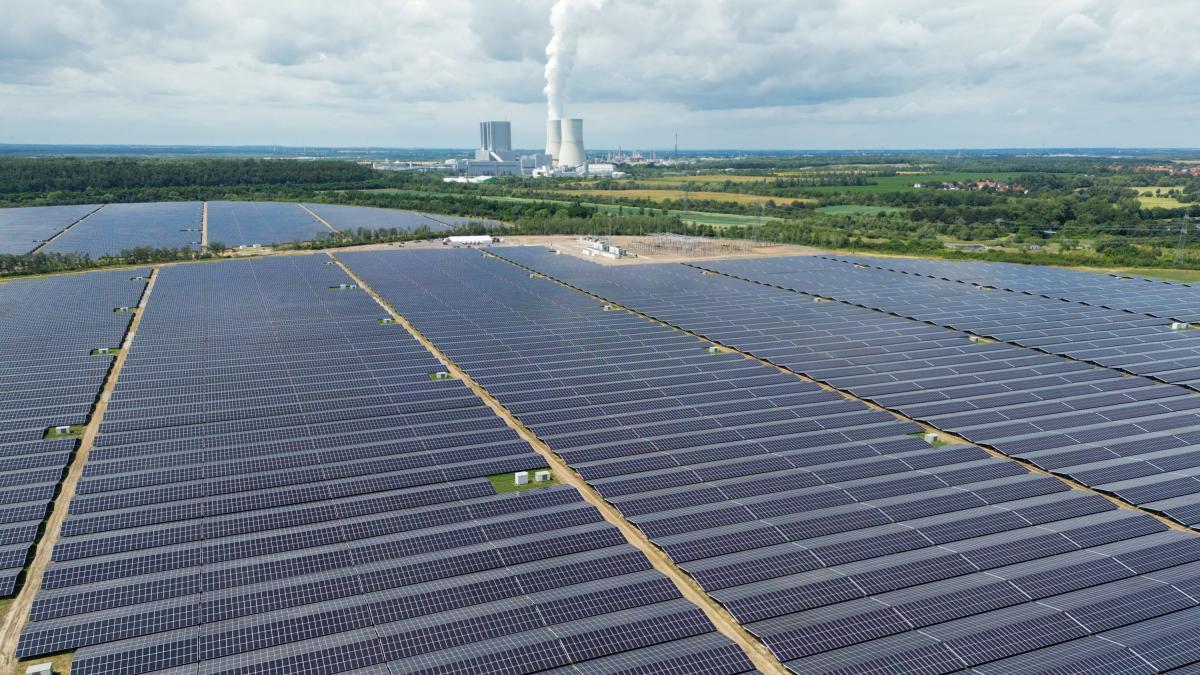
The government’s solar expansion targets are being exceeded. But the boom has consequences for the electricity grids. Battery storage is not being used optimally because there are no incentives for it, according to the analysis by the Institute for Economic Research. This can lead to bottlenecks in the distribution grids.
According to a study, the boom in solar energy in Germany is making it increasingly difficult to control the power grids. An analysis by the German Institute for Economic Research (DIW) in Berlin states that solar power generation is concentrated around midday on sunny days. “This can lead to temporary bottlenecks in the power grids, especially at the distribution network level.”
It is said that the existing flexibility in the grid integration of photovoltaics (PV) is not always used optimally. Recently, many PV systems have been installed in buildings in combination with battery storage. This allows households or businesses to increase the proportion of PV electricity they use themselves.
“However, there are few incentives to Use storage as network- or market-oriented as possible“Because neither the feed-in tariff nor, as a rule, the household electricity tariffs provide corresponding signals: remuneration and prices are the same for every kilowatt hour, regardless of the current market price,” the study states.
For example, it could happen that the PV storage systems are already fully charged during the hours of peak PV generation in the summer months and the systems then feed full power into the grid. This puts a strain on the local power grids. In order to manage power grids more efficiently, the study says that more speed is needed in installing “smart” electricity meters.
The expansion of solar systems has clearly picked up speedAccording to figures from the Federal Network Agency, the expansion last year doubled compared to the previous year to almost 14 gigawatts. According to the Ministry of Economic Affairs, the total output of installed solar systems at the end of June was more than 90 gigawatts. This means that the federal government’s target of an installed capacity of 88 gigawatts in 2024 has already been achieved. By 2030, the installed capacity is expected to be 215 gigawatts.
In order to achieve this expansion goal, the pace must increase even further, says the DIW study. The main driver of the expansion is currently a strong increase in smaller PV systems on buildings, which is attractive due to the advantages of self-consumption. “But alongside a lot of light, there is also shadow: there is still potential in open-space systems.” A key reason for the recent strong growth is the decline in the prices of solar modules.
Dependent on China for solar expansion
In recent years, very large production capacities have been built up, especially in China. However, these are currently far from being fully utilized, which is depressing module prices. China dominates the global PV production chain.
The expansion of PV therefore has another “dark side”. Since there is hardly any production of solar cells in Germany or the EU anymore, further expansion is heavily dependent on imports from China.
dpa/saha