
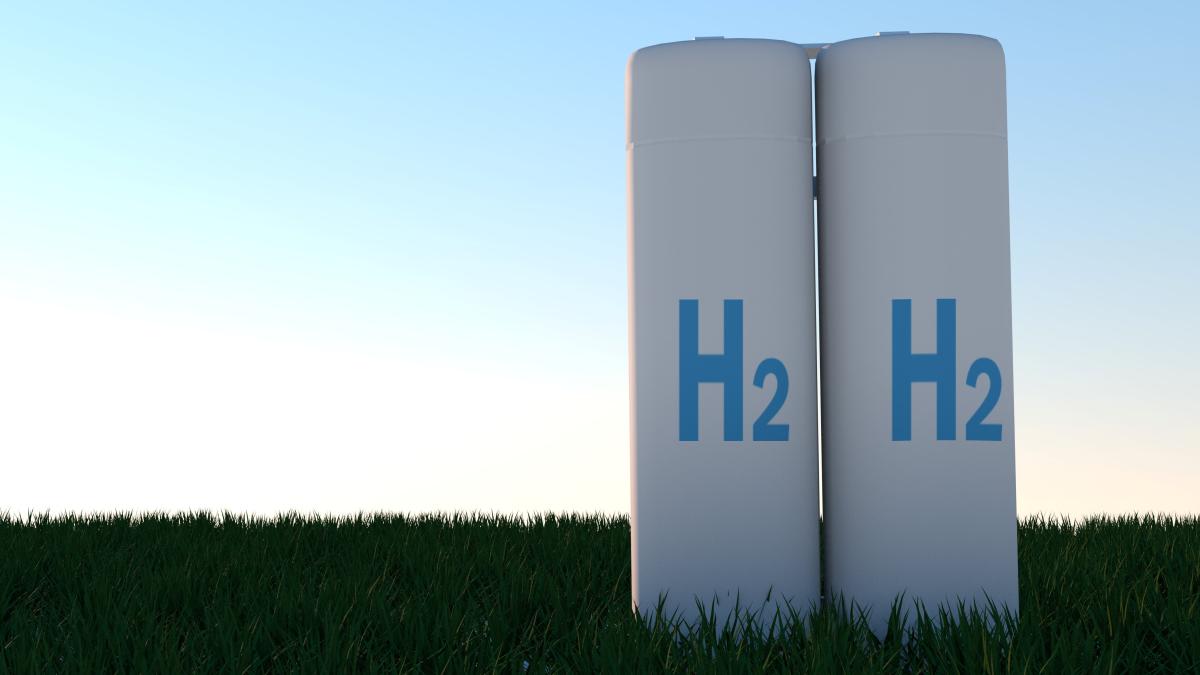
Storing hydrogen is expensive and complex. ETH Zurich wants to change that with a new technology. It uses excess solar power – and an easily obtained element. The first plant already exists.
The researchers at the Swiss Federal Institute of Technology in Zurich (ETHZ) have ambitious plans. As the university recently announced, they want to cover a fifth of the electricity needs of their Hönggerberg campus with solar power by 2026. In winter, however, when the sun shines less often, the scientists also want to use a hydrogen storage technology that was developed by the Department of Chemistry and Applied Biosciences at ETHZ and is now being used here as a pilot plant.
This is done with the help of excess solar power Hydrogen is produced by electrochemically splitting water. The gas is then fed into a stainless steel vessel where it reacts with iron ore, which is chemically nothing other than iron oxide. The hydrogen removes the oxygen from the iron ore. This creates elemental iron and water.
The researchers are convinced that this will make it possible to store hydrogen seasonally in a “safer and cheaper” way than current alternatives. This is because, apart from the production itself, storage is also a cost factor. To date, the construction of conventional storage systems has been very expensive because storing hydrogen requires special pressure vessels and cooling devices as well as the necessary safety precautions.
In addition, the hydrogen containers are never completely sealed, which can mean additional environmental pollution. According to ETHZ, this problem does not exist with the new technology. In addition, iron ore is easy to obtain, even in large quantities.
At the moment, however, hydrogen storage only works in a small pilot plant on the Hönggerberg campus. The hydrogen is currently stored there in three stainless steel tanks in the form of iron and water. The electricity required for hydrogen production also comes from the normal power grid. In 2026, it will then come from the solar systems on the Hönggerberg.
Currently, ten megawatt hours of hydrogen can be stored here, which can provide electricity for about four to six hours. To access this, hot steam must be fed into the boilers so that the iron and water are converted back into iron oxide and hydrogen. The gas then becomes the “fuel” for a gas turbine or a fuel cell, which in turn generates electricity and heat.
In order to cover a fifth of the campus’s electricity needs in winter, boilers with a storage capacity 450 times greater would be necessary. The future will show what role hydrogen will ultimately play in Switzerland’s electricity supply. At present, most energy experts assume that it will be cheaper to import the gas.
In contrast to the EU, which already defined in 2020 how it wants to develop the hydrogen economy in the future, Switzerland does not yet have a proper strategy. However, the Federal Council wants to present one this year. Last November, in a report in response to a corresponding postulate, it already indicated what role hydrogen should play in Switzerland in the future.
In the future, the fuel will be used primarily where there is no renewable alternative in the Swiss energy supply. This means primarily in high-temperature processes in industry, where fossil gas is still used today, among other things. Or in heavy goods traffic.
However, hydrogen is also increasingly being used as a fuel for reserve power plants, which the federal government sees as a safeguard in case the nuclear power plants are no longer connected to the power grid in winter and renewable electricity becomes scarce.
This article first appeared in the French-language daily newspaper “Tribune de Genève” in Switzerland. Translated from the French by Bettina Schneider.
The text comes from the newspaper cooperation Leading European Newspaper Alliance (LENA). In addition to WELT, the members include the Italian newspaper “La Repubblica”, “El País” from Spain, “Le Figaro” from France, “Gazeta Wyborcza” from Poland, “Le Soir” from Belgium and “La Tribune de Genève” and “Tages-Anzeiger” from Switzerland.