
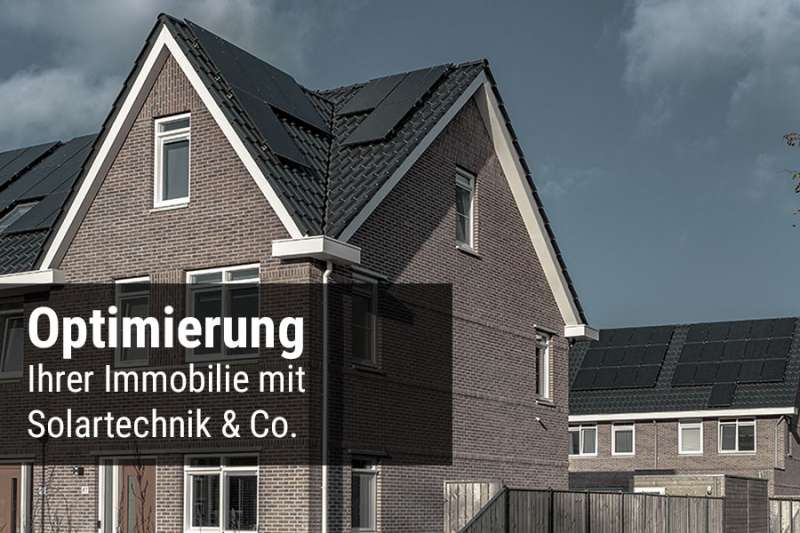
The sun can not only heat water, but also generate electricity using photovoltaic elements. Roof areas and facades on private houses that would otherwise simply remain unused are suitable for this purpose. If these areas are used sensibly to generate energy, a house can become at least partially independent of energy supplies. In any case, various economic savings are possible.
1. The technical options for generating solar energy
These depend on the size, location and orientation of the available space on the building. It is best to integrate the use of solar energy into the design of the house right from the start.
In air collectors, warm air is generated behind a pane of glass that is illuminated. This type of energy from the sun is obtained to a certain extent in practically every house. The warm air can be directed via shafts to areas that are not directly behind the pane of glass.
Hot water is produced in collectors and can be used both for direct use and to support heating. Electricity is produced in photovoltaic elements. If it is not used immediately, it can be stored in a battery.

2. The organizational implementation of solar energy generation
The best way to implement this is based on an overall concept that takes the long-term perspective into account. Collectors for hot water and photovoltaic elements for electricity generation should be coordinated with each other.
A solar consultant can help with this and also explain to the homeowner the options for the available subsidies. You can find out how roof windows can be subsidized for example here.
For a variety of reasons, renovation work needs to be carried out on a house on a regular basis. It is therefore very sensible to include the use of solar energy in this work. If the roof needs to be repaired, for example, this is an opportunity to install solar modules.
Another option is to renovate the systems for heating and providing hot water. Since solar panels feed hot water into these systems, a corresponding expansion is an obvious choice.
An often overlooked area is next to the roof the facade of the houseModules for using solar energy can also be installed there.
However, appropriate adjustments also allow the passive use of the sun without any collectors.
- Depending on the architecture, the windows can be enlarged, which reduces the need for heating.
- Plants on or in the immediate vicinity of the house reduce the need for cooling in summer.
3. Solar energy and architecture
Of course, specialists are needed to carry out the work. However, it is often overlooked that the use of solar energy is also a task for architects. The necessary elements can be harmoniously integrated into the design of the building (see e.g. https://www.energieschweiz.ch/gebaeude/solare-architektur/ This applies not only to the house itself, but also to the surrounding area, such as an embankment.
It is therefore worth consulting an interested architect. The modules for using solar energy do not have to detract from the visual impression of a property, they can even enhance it. They can be used to shade conservatories or terraces.
Not only the south side of the house is interesting, but also the southwest and southeast directions.
Collectors for hot water require relatively little spaceFor this application, it is obvious to take into account the low winter sun, so that the modules should be positioned at an angle. Installation on the facade is also conceivable. Vacuum tube collectors are more efficient than conventional ones and only need about two thirds of the area for the same output.
Even if the winter sun is not enough to achieve the desired water temperature, its effect should not be underestimated. Every degree of warming allows for significant savings in the energy sources that would otherwise be required. This applies to oil and gas as well as to renewable raw materials such as wood.
Photovoltaic elements require more space than hot water collectors. It is a good idea to get quotes from different companies before installing. It is desirable to have the opportunity to join a larger order of elements, where economies of scale can provide price advantages. However, the elements themselves should definitely come from reputable manufacturers in order to be able to deliver reliable performance over their entire service life. The same applies to the installation company, which should have extensive experience with this type of work.