
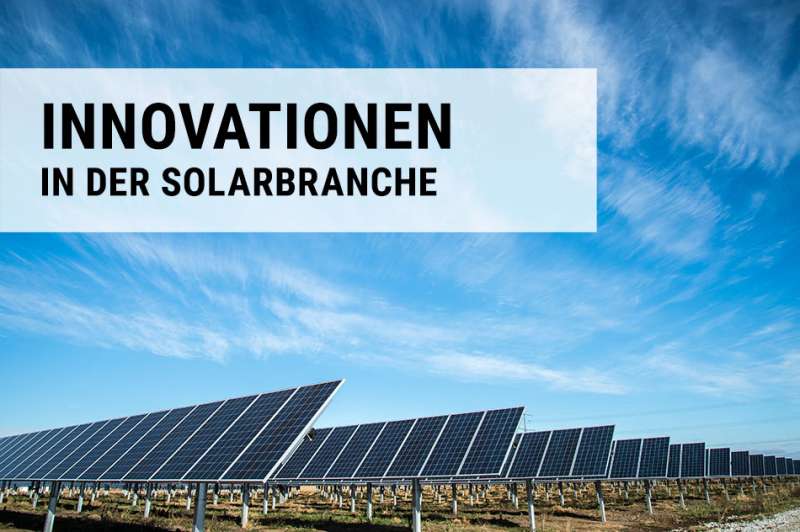
Summers are getting hotter and hotter and the topics of climate change, environmental protection and renewable energies are on everyone’s lips. This makes it all the more important to find out about the future of the solar industry.

1. The role of automation and process technology in the solar industry
In recent decades, the solar industry has grown significantly and is now a significant sector in the energy supply. Automation and process technology play an important role in this, as they lead to increased efficiency, improved product quality and reduced costs.
Automation technologies are mainly used in the production of solar cells and solar modules. This can improve the process flow and reduce the use of manual labor. Robots and automated production lines can be used to speed up the production of solar cells and modules and to improve the quality of the products. The latter can also be achieved through automated inspection systems that monitor the processes.
Automation processes are used in various areas of the solar industry. In solar thermal energy Automation is used to optimize the operation of solar thermal systems. Sensors can measure solar radiation and automatically adjust the solar thermal systems to this. This maximizes energy yield and minimizes maintenance effort.

Also in solar power generation Automation is used to improve the operation of solar systems. Especially in large solar parks, automation can help monitor the performance of solar systems and optimize their maintenance. Sensors help to detect errors at an early stage so that they can be corrected promptly before they lead to costly failures.
In addition to automation, process technologies are also used in the solar industry. They serve to improve the production process. Nanostructures can optimize solar technology to increase energy yield. Innovative process technologies can also reduce production costs while improving product quality.
2. Increasing efficiency through advanced manufacturing methods
Increased efficiency can be achieved by using advanced manufacturing methods, particularly in the following areas. Automated manufacturing processes reduce production costs. At the same time, production errors are minimized through automated quality controls. Robot-assisted production lines increase production speed.
Digital data processing and analysis help to better plan and monitor production, while the use of advanced materials and manufacturing techniques such as 3D printing processes allows the production of complex components. The flexibility of advanced manufacturing methods opens up more possibilities for personalized production and automation minimizes manual labor and potential safety risks.
3. Growth potential and global impact of the solar industry
While the solar industry has grown considerably in recent decades, the future of solar power Reasons for even stronger growth. Important factors include:
-
The falling prices of solar technology: Prices for solar cells and modules have been falling for several years, making solar power generation more cost-effective and encouraging the growth of the solar industry
-
The increasing demand for renewable energy: Due to concerns about climate change, environmental sustainability and energy dependency, the demand for renewable energy is increasing worldwide. The solar industry is also benefiting from this trend
-
Advances in innovation: Continuous technological advances are increasing the energy efficiency of solar cells and modules while reducing production and installation costs
-
Government incentives: Governments around the world are supporting initiatives that promote renewable energy, which is also accelerating the growth of the solar industry and steadily increasing its global adoption
-
Positive economic impact: The solar industry also leads to more jobs and higher investments, and solar energy products can improve energy security and reduce dependence on fossil fuels
In summary, it can be said that automation and process technology in the Solar industry are of central importance and, along with a number of other factors, will promote even stronger growth in the industry. The high growth potential of the solar industry also plays an important role in achieving global climate goals. By using solar technology, CO2 emissions can be significantly reduced and a sustainable and environmentally friendly energy supply can be guaranteed.