
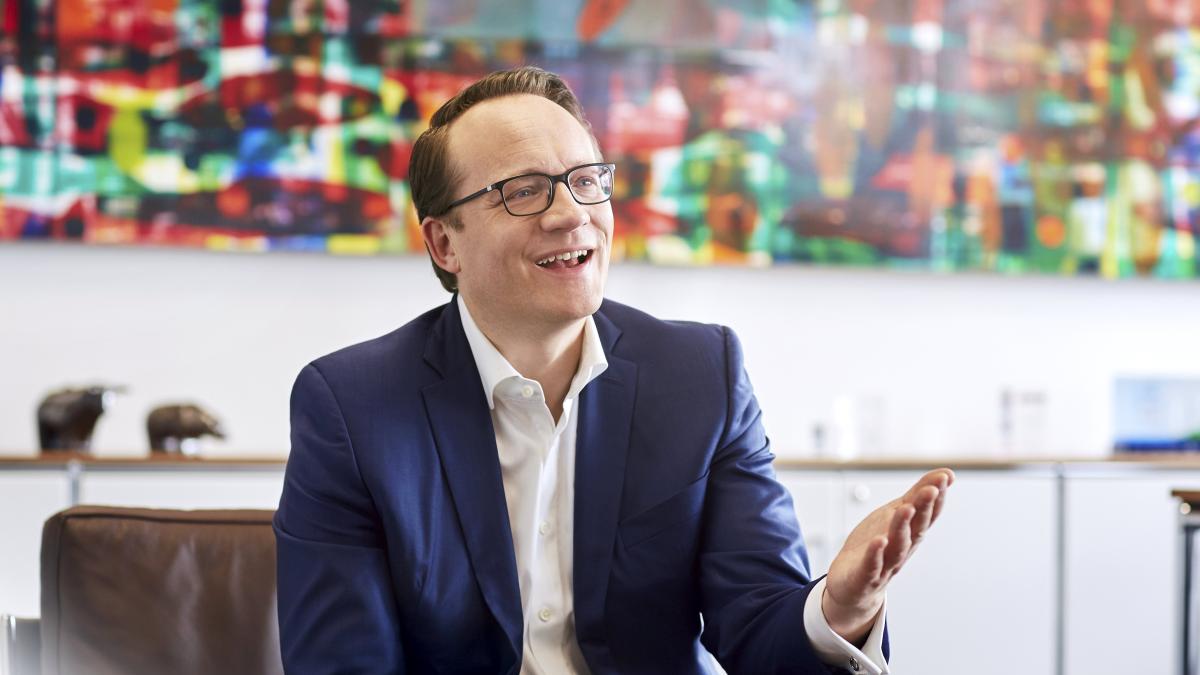
Markus Krebber recently pointed out the dangers of a power shortage caused by so-called dark lulls. Now the RWE boss is upping the ante again. However, he rules out a renaissance in nuclear energy.
The pace of expansion of renewable energies is too slow, Germany is struggling with home-made problems in the electricity market: RWE boss Markus Krebber caused a stir with this thesis a few weeks ago.
In a longer opinion piece in the career network LinkedIn the economist recently pointed out the volatile situation in the German power grid. On the evening of November 6th, the price for a megawatt hour of wholesale electricity reached a dramatic peak and was ten times more expensive than usual. On cold, dark winter days, there was and is always a high demand for electricity, especially in the evening hours, which solar systems and wind turbines cannot meet.
A copy of the posting circulated a little later on the online news service X, and was maliciously commented on by a US lobbyist for nuclear energy. First the German electricity suppliers spoke out in favor of the energy transition, now they would panic after a lull in the wind, Mark Nelson blasphemed.
On the message Tesla boss Elon Musk then reacted, although he was less upset about the content and more about where it was published. “I am losing respect for anyone who posts on LinkedIn,” Musk wrote. And further: “LinkedIn is truly the worst ‘social media’ app there is. “I should buy it and shut it down,” the X owner said.
The person so scolded now submits a detailed statement Interview in the “Handelsblatt Disrupt” podcast after. There Markus Krebber explains his concerns again, but defends the German concept of the energy transition and in this context also rules out a return of nuclear energy – with a surprising reason.
“The energy transition is the right path,” Krebber now makes clear
In the interview, the 51-year-old manager, who has been at the helm of the former coal giant for almost three years, defended himself RWE is, first of all, the switch to renewable energies. Despite the high costs and sometimes slow implementation, “green” electricity is the future: “That is what is in demand. And it is what is competitive. The energy transition is the right path,” says Krebber.
When asked whether there could be more days like November 6, 2024, with possibly even worse consequences, he replied: “I can’t tell you how often that will be, but we can’t rule them out. And the energy system should not be left on edge because security of supply is a valuable asset.”
As a remedy, Krebber then suggested a kind of back-up system. “Countries like Poland, Belgium and Great Britain have set up so-called capacity markets in which suppliers are paid for operating power plants that can only step in in an emergency. An instrument like this isn’t expensive at all.”
RWE boss calls for climate money
Specifically, in the conversation, the business boss suggested the introduction of so-called climate money for industry and consumers. “In Europe we currently have CO₂ prices of around 75 euros. This brings the federal budget almost 20 billion euros in income per year. If this money is used in the form of climate money to cushion the social consequences or to relieve pressure on energy-intensive industries, then it can succeed.”
In the podcast, “Handelsblatt” editor-in-chief Sebastian Matthes then points out various US tech companies that are now considering covering their (immensely high) energy demand again with nuclear energy. Can Krebber, as an energy manager, also imagine such a solution for Germany, which has only just taken its last nuclear power plants offline?
Krebber points to the alleged lack of acceptance among the population: “In this debate, we must not overlook something essential: we need a social consensus.” When asked that, according to surveys, such a majority is very conceivable, the RWE boss remains firm : “But it’s a slim majority. Such a project would have to be supported by a much broader majority. I don’t see that in Germany. We as a company do not go against a social consensus.” And in Germany it is clearly in favor of the energy transition, he concludes.
He also speaks out against restarting the three German nuclear power plants that were recently shut down: “We need a completely new approval process for this. In addition, it would require massive investments, and we are not talking about small amounts, to bring the systems up to date with the latest technical standards. And there simply isn’t enough staff to do it.”
Markus Krebber closes the conversation with a passionate plea for sustainably generated energy. In doing so, he takes a decisive stance against the critics of the energy transition. “If a false narrative were to take hold, along the lines of: The problems we have are because the energy transition is not working and we only have to reverse it halfway, then all our problems will be solved. That would be fundamentally wrong.”
crooked