
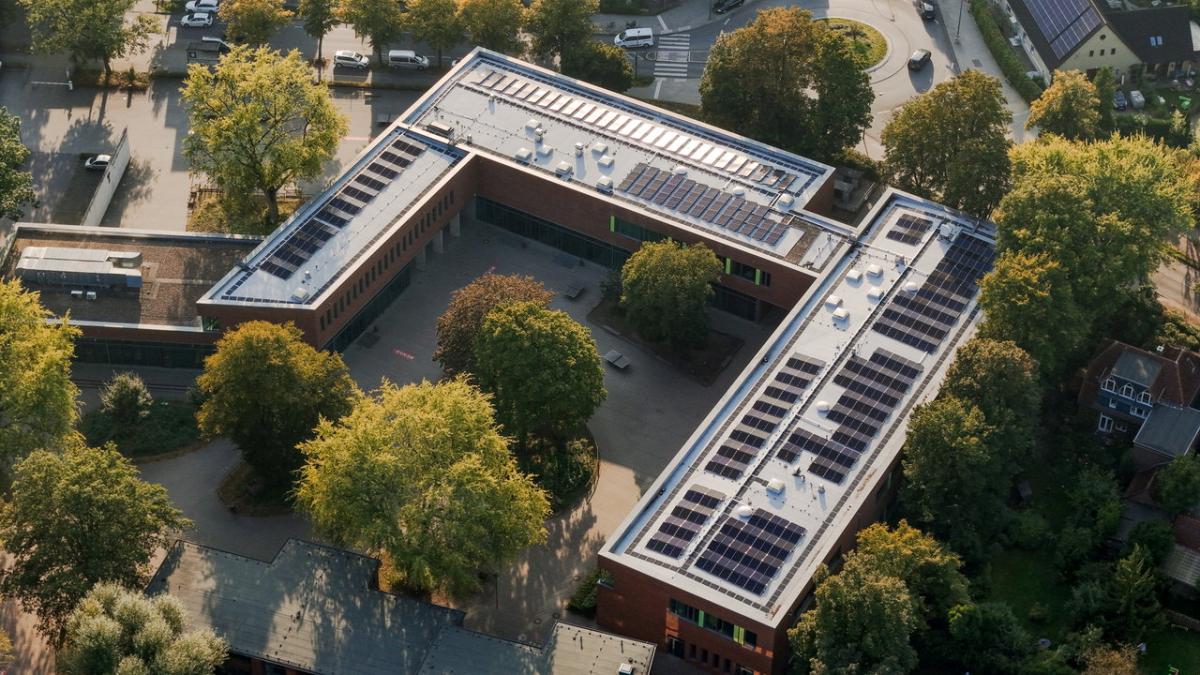
Hamburg wants significantly more photovoltaic systems on the roofs of the Hanseatic city. Hamburg’s school buildings should also have as many solar panels as possible. The potential is still great. But the expansion is finally progressing well, it was said during an on-site visit.
Hamburg has strict climate goals. By 2030, 70 percent of the CO₂ emissions from the comparable year 1990 should have been saved, and the Hanseatic city should become climate neutral by 2045. One has been in effect since the beginning of the year Solar and green roof requirements. The city has wanted to set a good example for much longer. photovoltaic systems built on a large scale on public buildings should help. However, expansion was slow for many years. The city even founded its own company in the meantime Hamburg Energy Solarto get more photovoltaics on Hamburg’s roofs.
Things seem to be going better now. At least that’s the impression that two male and female senators tried to convey on Wednesday, who, together with representatives of the Hamburger Energiewerke (HEnW), were guests at a district school that already has a photovoltaic system and is getting a second, much larger one. According to the embassy, the expansion of Hamburg’s school buildings is making progress. With at least 3,000 school buildings at 460 locations, they make up a large area of the roof areas of public buildings.
A good two years after the initial call for the installation of photovoltaic systems in Hamburg’s schools, 62 systems are in operation or under construction. A further 64 systems are planned by 2025, the school authorities said. The maximum output then increases to almost 8.5 megawatt peak. Mathematically, around 3,400 two-person households could be supplied with electricity from Hamburg’s school roofs each year. In fact, the electricity from the roofs is used to power the schools. Energy that is not consumed locally is fed into the power grid.
“Hamburg’s schools are exemplary when it comes to climate protection and the energy transition, already now and even more so in the next two years with a doubling of systems on school roofs,” explained School Senator Ksenija Bekeris (SPD) during a visit to the Gyula Trebitsch School in Hamburg-Tonndorf. A solar system with 70 kilowatt peak has been in operation there since February 2024. A system with 140 kilowatt peak is currently being installed on the neighboring building.
“Our goal is for every school location to be equipped with a high-performance PV system,” emphasized Bekeris. photovoltaic systems have been planned as standard for new buildings for years, and the roofs of existing school buildings should gradually be made PV-ready, i.e. prepared for the installation of solar systems to generate electricity.
Finance Senator Andreas Dressel (SPD) is responsible for the municipal buildings. He emphasized that the topic of photovoltaics offers huge potential because the many school properties and buildings offer appropriate space for it.
Environment Senator Jens Kerstan (Greens) emphasized: “In order to achieve our goal of increasing the electricity supply in Hamburg In order to make it almost climate-neutral by 2045, we need a diverse package of measures.” The expansion of solar systems plays a central role in this. He is pleased that “we are really gaining momentum in equipping our schools with solar systems.” This is not only an important contribution to climate protection, but also an investment in the future of children, who can experience first-hand how renewable energies work.
The opposition was not as enthusiastic as the three Senate members. The Senate is celebrating the expansion of photovoltaic systems in Hamburg’s schools as a success, but the actual progress falls short of what was announced, said Sandro Kappe, environmental policy spokesman for the CDU parliamentary group. According to a request from the parliamentary group in July 2024, only two percent of municipal buildings are equipped with photovoltaic systems – that corresponds to 255 of a total of 10,748 buildings.
“The expansion of photovoltaic systems is progressing far too slowly,” criticizes Kappe. “The Senate must act now instead of praising itself for minimal progress.” The expansion must be significantly accelerated in order to achieve the climate goals.
juve