
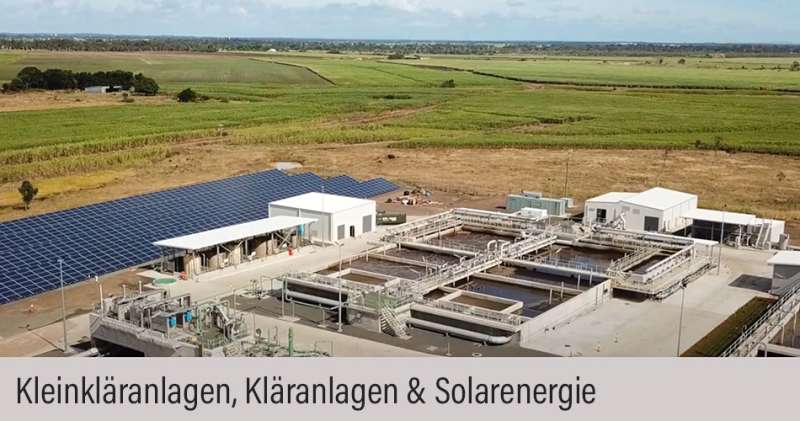
There are many buildings in Germany that are not connected to the public sewage network. Here, it is required by the authorities to treat the wastewater in your own small sewage treatment plant. But what does this topic have to do with solar cells?
These include, for example:
- Restaurants
- Hotels
- Leisure facilities
- Campsites
- Pursue
- Residential areas
1. Operating small sewage treatment plants with solar power: Why does it make sense?
Many of these properties can offer good conditions for photovoltaic systems due to their roof areas or open land. In extreme cases (as in some mountain huts) an independent power supply is even essential.
Here, the solar system with power storage can not only supply the energy for the building, but also simultaneously perform the function of a technical Small sewage treatment plant guarantee.

Depending on the system, these systems require more or less electrical power for:
- pump
- Engines & Ventilation Systems
- the electronic control
The power consumption here is usually relatively continuous throughout the day, as pumps or compressors work in intervals. In addition, many systems can be programmed so that the necessary ventilation of the small sewage treatment plant takes place preferably during the hours of sunshine during the day. This is the period when the photovoltaic storage system may already be full and the solar power generated would otherwise be sold to the grid. It is more economical to use the power yourself, which can support the targeted control of the small sewage treatment plant.
This means that the solar power generated can be used directly during the day and the excess energy stored in batteries can be used up at night.
So when you are planning your solar system, you should definitely not forget the consumption of the small sewage treatment plant. The sewage treatment system is an easily calculable consumer, as, as mentioned, the electricity is consumed continuously.
Other consumers, such as a washing machine or an electric stove, experience high peak loads. It is sometimes recommended to use such high-power consumers during the sunny hours of the day – when more energy is generated than can be stored in the solar storage system. Such “problems” simply do not arise when calculating the energy consumption of a small sewage treatment plant. The systems can therefore be very easily integrated into the solar concept.
2. Are there sewage treatment plants with photovoltaic systems?
A sewage treatment system that is offered directly with photovoltaics can be found from the manufacturer Kingspan Group. The Kingspan Modular BioDisc® offers significant savings in energy costs thanks to the optional solar support.
The models can be built modularly and cover the biological wastewater treatment for 250 to 2,500 people. There is not only a modern remote monitoring solution including an automatic alarm function but also the solar power supply mentioned. According to the manufacturer, this means the system can produce up to 80 percent of the energy it needs. https://www.kingspan.com/de/de-de/produktgruppen/abwasseraufbereitung-biologe-abwasserreinigu/downloads/biodisc-bh-bl).
A larger project was planned by the “Zellinger Becken” wastewater association. With 227 modules, a peak output of 87 kilowatts and an annual yield of over 92,000 kilowatt hours (kWh), the municipal sewage treatment plant would be supplied with solar power.
The proportion of self-consumption would be over 96 percent. Together with the existing CHP plant, which generates energy using the digester gas from the sewage treatment plant, around 44 percent of the energy can be generated in-house. The proportion of solar energy here is 14 percent and the solar system would be financed after 12 years through the electricity cost savings (https://www.mainpost.de/regional/main-spessart/klaeranlage-mit-photovoltaik-stromkosten-sparen-art-10232635).