
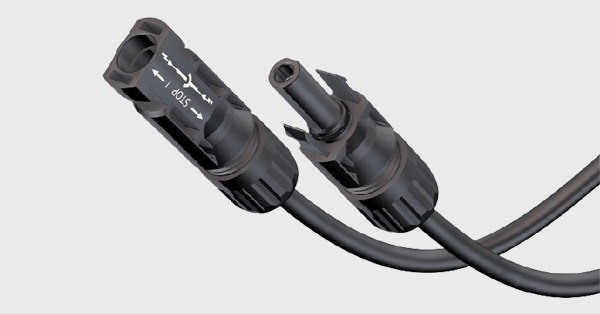
Solar panel connectors are one of the most underrated components in photovoltaic (PV) systems, but they are one of the most important. Improvements in solar connector technology have brought benefits to solar installers the ability to easily and quickly install solar systems that will last for decades. All connections remain secure unless intentionally disconnected for maintenance or other reasons.
If you are interested in learning more about solar panel connectors, this article will provide you with all the information you need. Here you will learn the basics about solar panel connectors, how to connect the different types of solar panel connectors, what their main specifications are and which one is best for you.

Starting with the basics
Before diving into the world of solar panel connectors, it’s a good idea to get the basics down. In this section we explain what they are, their evolution throughout history and more.
What is a solar panel connector?
Solar panels come with wires that connect to the junction box on one end and to a solar panel connector on the other end. The solar panel connection takes some getting used to Connect solar modules in PV systems with each other. Their main task is to ensure electricity continuity and flow throughout the solar field. There are many types of solar connectors on the market, but the most popular option available is the MC4 connector.
A Brief History of Major Solar Panel Connectors
PV technology was first Invented in 1883, but the technology didn’t become popular until the 1950s, when it caught the attention of Bell Laboratories. With the increasing number of applications for PV technology, there was a need for a safe and easy to use solar panel connector and so MC3 solar connectors were developed.
The MC3 solar connector was invented in 1996, named after Multi-Contact (MC), the company that invented itand the 3mm2 Size of the built-in contact pin. Developed in 2004, the MC4 solar connector is an improved version of the MC3 connector with a 4mm diameter2 Contact pin, an efficient safety mechanism and a convenient installation that have made it a standard in the solar industry.
Why Are Solar Panel Connectors So Important For Solar PV System?
Solar panel connectors hold PV cables securely in place and withstand decades of rigorous exposure to the elements and sunlight. This safety mechanism also reduces arcing and makes solar systems safer.
Another important role of solar panel connectors is to reduce electrical resistance between PV modules by properly terminating wires. This reduces electrical hotspots (not the same as solar hotspots) that could otherwise overheat cables or connectors due to loose connections or other factors. This also makes PV systems much safer by reducing potential fire hazards.
How Are Solar Panel Connectors Selected?
MC4 connectors have become the standard in the solar industry, but there are several other solar connectors still in use by some installers. Some of these are Amphenol, Tyco, Radox and the legacy MC3 solar connector.
To select the right solar panel connector for each application, installers consider various features and technical specifications. The list below shows some of the most important factors to consider when choosing a solar connector:
- max voltage
- max current
- maximum temperature
- contact resistance
- contact material
- Ingress Protection (IP) Index
- security class.
- Wire gauge (wire size).
Solar Panel Connectors: How Are Solar Panel Connectors Used?
If you own a PV system, it is extremely important that you learn how to use solar panel connectors. In this section, we will teach you how to attach a solar connector to a cable, latch or unlatch it, and install it in series, parallel, and serial parallel.
Crimping and tightening solar panel connectors
Solar modules are not always supplied with a solar plug connected. Attaching a solar panel connector to a PV cable involves two steps: (1) crimping and (2) tightening the connector. You will need wire strippers, a crimping tool and a solar panel connector assembly tool to do this.
- First you strip the wire, then place the metal connector on top and finally use the crimping tool to crimp the metal connector to the wire.
- After the metal conductor is crimped to the wire, you need to insert the metal connector into the terminal cover, strain relief, and compression sleeve.
- Finally, you insert the metal connector into the connector housing and screw all components together with the assembly tool. Proper tightening of MC4 solar connectors ensures they are waterproof and safe to use.
Locking and unlocking solar panel connectors
The connections for solar modules have a Locking and unlocking mechanism This keeps them in place and reduces the risk of electrical hotspots and arcing. This mechanism also makes it easy for solar installers to connect the entire solar system.
To latch an MC4, Amphenol, Tyco, Tonglin and Hosiden solar connector, it is simply a matter of mating the male and female connectors until the security pins are inserted. All connectors should be unlocked with the assembly tool, but the MC4, Tonglin and Hosiden connectors can be unlocked by pressing the safety pins while pulling the connectors.
Radox solar connectors are locked and unlocked using a screw mechanism. You insert the solar plugs and sockets until there is a 2mm gap between them, then screw them together. To separate them, perform the reverse process.
Installation of series, parallel and series-parallel solar panels with solar connectors
Solar connectors can be used Connect solar panels serial, parallel or serial-parallel. Installation in series is quite simple, while parallel installation requires an additional component.
To connect solar panels in series, simply plug the positive lead of one PV panel into the negative lead of the next panel. At the end of the string, connect the minus plug of the first module to the inverter with the plus plug of the last one.

To connect solar panels in parallel, you need an additional component called MC4 Combiner (or MC4 Multi-Branch Connector), this name differs for other types of solar panel connectors. The image above shows a 4-in-1 MC4 combiner, but these components can be 2-in-1, 3-in-1, etc. By using a 4-in-1 MC4 combiner, you can connect up to 4 solar panels (or strings of panels) in parallel. To do this, all positive lines of the 4 PV modules are connected to a single MC4 combiner. Then the negative leads of the 4 panels are connected together via another MC4 combiner. This results in just two wires carrying all the power from the solar panels which can be easily connected an inverter.
For the series-parallel connection, apply what you just learned to connect two or more strings of solar panels in series in a parallel circuit.
What Are The Main Types Of Solar Connectors Used In The Solar Industry?
MC4
The MC4 solar connectors have become the standard connector in the solar industry. Invented by Multi-Contact/Stäubli, this connector meets the strict requirements of the National Electrical Code (NEC) and also features a safety locking mechanism, making it ideal for most installations.
amphenol
Amphenol is a solar connector manufacturer that has released several solutions for PV installations that are similar in design to the MC4 connector, except this connector requires unlocking of the assembly tool.
Tyco
Tyco Electronics also develops all types of solar connectors as part of the SOLARLOK product line. The SOLARLOK PV4 connector is UL and TUV certified and conforms to NEC regulations.
MC3
The MC3 solar connector is usually considered a legacy solar connector, but it is still used in some PV applications. This connector has similar specifications to the MC4 but without the safety mechanism.
Radox
The Radox Twist Lock solar connector designed by Huber + Suhner is UL and TÜV certified, has a housing and contact element made of high-quality beryllium copper for the power supply, high mechanical strength, UV and ozone resistance, and a simple assembly system.
Comparison of the different types of solar panel connectors
The best way to better understand the options available is with a table. In this section, we compare each of the most popular solar connectors by also listing their specifications.
Most solar connectors generally share similar technical specifications, but the small variations make them unique. The MC4 could be considered that best option overall as it can carry higher current and is more practical to use.
Originally manufactured by Multi-Contact, the MC4 connector has become the industry standard for a variety of reasons. This connector features high-quality materials and MULTILAM technology, which increases the tension between the socket and plug connectors to reduce moisture inside the connector and improve performance. These and other reasons are why Using an MC4 Original may be your best bet.
Final Word: The Importance of Choosing the Right Solar Panel Connector
Choosing the right solar panel connector will ensure your PV system runs smoothly for decades. You might do maintenance every few years, but you will most likely never change the solar panel connector if you use the right one.
For 600V residential installations most solar panel connectors will do the job and function for the duration of the installation, however we strongly recommend MC4 connectors. The MC4 connector has been tested in all types of environmentsis designed for the toughest conditions and is constantly being improved, The latest version released by Stäubli is the MC4-Evo 2.