
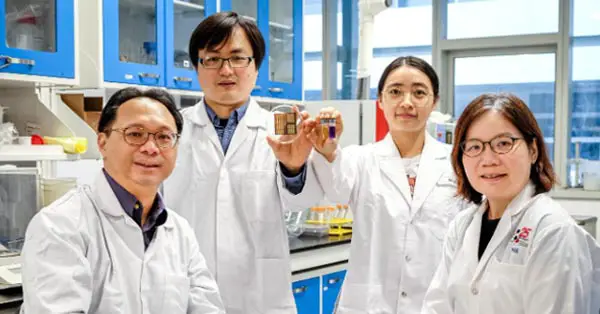
Research led by scientists from Nanyang Technological University, Singapore (NTU Singapore) announced the results of using non-toxic metals with a new approach to fabricate the top layer of perovskite solar cells, making the cells more environmentally friendly while maintaining high conversion efficiency.
Ever since the first perovskite-based solar cell was released in 2009Scientists have been striving to find new materials and manufacturing techniques to improve the efficiency and stability of perovskite cells.
Another reason that hinders commercialization is the environmental exposure of the toxic elements in the cells. Perovskites can degrade when reacted with moisture and oxygen, exposed to light and heat, or used over an extended period of time. If the cell is damaged or discarded, the toxic heavy metal lead from the perovskite material and top coat (applied to the perovskite layer to protect the cell from environmental stress and enhance its performance) can pose environmental hazards.

When the traditional semi-precursor (HP) process is used, lead ions must be pulled up from the underlying perovskite layer to form the protective overcoat. However, with the FP method, the chemicals in the compound solution can react with each other directly on the surface of the perovskite layer, which is more effective.

Using the FP method, scientists created a 1-inch by 1-inch prototype perovskite cell covered with the zinc-based compound. After an electron microscopic and spectroscopic study, they found that the zinc-based top layer did not affect the electrical properties of the underlying perovskite layer, while helping to cover defects on the surface of the perovskite layer and improve its light-gathering abilities. In experiments using simulated sunlight, the prototype cell was able to convert 24.1% of the light into electricity, close to the previous highest record achieved by perovskite solar cells.
The scientists also say that the new process contributes to efforts to make the perovskite layer more environmentally friendly, stable and efficient because it does not require extraction of lead ions from the perovskite layer to produce the traditional lead-based top layer, opening up new possibilities for applying other materials to reform both the perovskite and cap layers thus optimizes the overall performance of the cell.
The Institute of Materials Research and Engineering (IMRE) of the Agency for Science, Technology and Research (A*STAR) in Singapore also participated in the research.
Details on the study can be found in Nature Energy in February 2023. Scientists are working to scale up the method to produce full-size cells.