
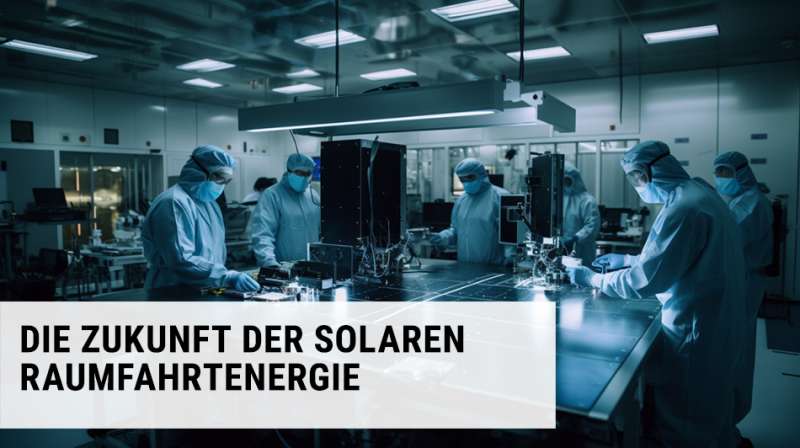
As part of British Science Week, Lockheed Martin has announced a £150,000 investment in Northumbria University to accelerate a project looking at delivering solar space power. The project combines science and technology, using specialised photovoltaic cells to convert laser energy into usable electricity for future space and lunar vehicles.
With this year’s British Science Week theme being ‘connection’, this technology could enable future applications such as solar-based space power, providing a consistent source of energy in all weather conditions and at any time of day. By harvesting the sun’s energy, this new form of solar power could potentially wirelessly send electricity from space to Earth, creating a new source of carbon-free energy that connects homes and businesses without the need for major land-based infrastructure.

Paul Livingston, CEO of Lockheed Martin UK, said: “Our collaboration with Northumbria University will advance the use of solar space power for satellites, spacecraft and potentially usable energy on Earth. We are excited to support the growth of the space economy in the North East and the industrial capacity and resilience of the UK’s space and manufacturing sectors.”
The collaboration follows years of successful experiments by Lockheed Martin with laser-based systems and builds on the company’s existing relationship with Northumbria University. This new project is an extension of the partnership announced last year, through which Lockheed Martin has invested over £600,000 in developing skills, research and technology in the North East.
Professor John Woodward, Faculty Pro-Vice-Chancellor of Engineering and Environment at Northumbria University, added: “Northumbria University is a UK leader in photovoltaic and solar energy research. Our reputation for world-leading research in space and satellite technologies has grown exponentially in recent years. This exciting project with Lockheed Martin combines these areas of excellence and will enable us to find further innovations in renewable energy generation and storage.”
Northumbria University’s solar and space researchers are working to understand the physics of the Sun and all aspects of the solar terrestrial connection to improve space weather forecasting. They are also improving satellite technology to better protect and exploit humanity’s use of space, including establishing a state-of-the-art space engineering laboratory and training the next generation of space-related engineers and instrument teams.
They demonstrate international leadership in theory, numerical modelling, observations of solar and space plasmas, data-intensive science and space-related hardware, and work extensively with partners such as UK Research and Innovation, the UK Space Agency, the European Space Agency, the UK Met Office and over 40 industry partners.
As part of Lockheed Martin’s commitment to promote and celebrate awareness of science, engineering and technology among a wider audience, the company recently hosted an event for the SME community at the Discovery Museum in Newcastle. In addition, Lockheed Martin brought together supply chain representatives at the Skills and Supplier Summit in Tyneside and launched the Team Athenas Space Camp in Newcastle to equip the next generation with the skills needed for successful careers in the space and technology industries.