
With a solar system, homeowners can make themselves less dependent on the energy market and make a valuable contribution to climate protection. Self-generated electricity is particularly worthwhile if you use most of it yourself. To ensure that the investment does not cause financial bottlenecks, all conceivable savings opportunities must be used when purchasing and financing.
1. Solar, solar thermal or photovoltaic system?
There is often confusion when it comes to terms relating to the use of solar energy for generating energy. To understand: Solar systems are both systems that generate electrical energy and systems that convert solar energy into thermal energy.
Photovoltaic systems are used to generate electrical energy. Solar thermal systems are installed to generate thermal energy or heat. In the linked articles you will find further details and videos explaining the functionality of the systems.
2. The cost of solar panels
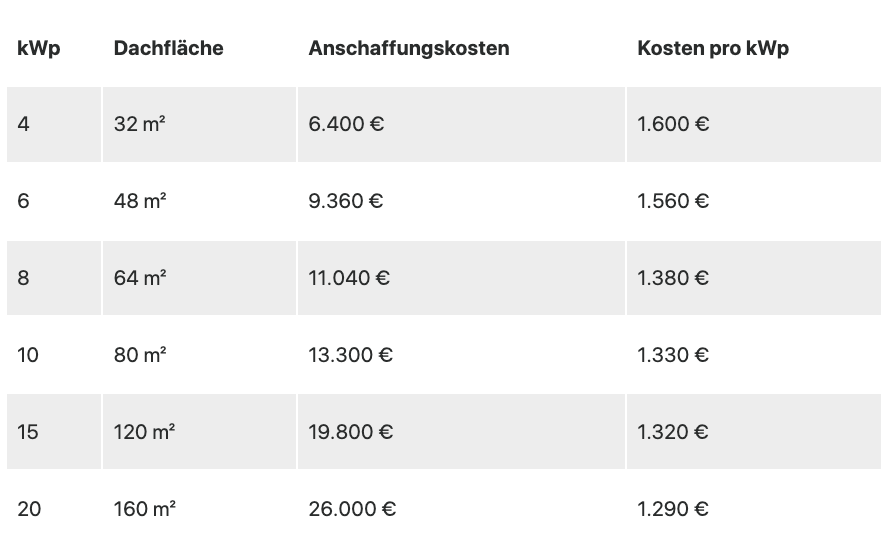
The price range for solar systems is large, as the individual costs depend on various factors. These include the performance, the roof area and the funding opportunities. For example, a small photovoltaic system With 5.5 kilowatt peak (kWp) and an area of less than 30 square meters, it is significantly cheaper than a powerful model with 13 kWp and over 60 square meters of space.
Prices between almost 7,000 and 15,000 euros are common for photovoltaic systems for single-family homes. The small example system mentioned here quickly costs more than 15,000 euros in a turnkey version including installation. With the large model, the prices can double. If an energy storage device is added, homeowners should expect at least an additional 6,000 euros.
In order to be able to compare the prices of different providers, interested parties need the price per kWp. The following table provides information about the average Net costs for photovoltaic systems and should serve as a guide:
In the article on the prices for solar thermal systems, we have already discussed the costs in detail. A household of four should calculate around 5,000 euros for four to six square meters of collector area with a solar system for hot water generation. The assembly costs and a solar storage are included in this.
finance solar systems
Buying a solar system is a sensible investment in the long term. With financing, they can also be afforded by those who do not have sufficient reserves. A typical variant for financing is the so-called modernization loan Since these are usually awarded by classic building societies, the choice is limited and not every household can meet the creditworthiness requirements.
3. Check online loans as an alternative
Property owners with a negative Schufa entry may be confronted with a loan refusal when financing solar systems from traditional banks. Before potential borrowers rely on dubious offers from abroad that promise loans without a Schufa credit check, it is worth taking a look at credit intermediaries with alternative online loans. Below that auxmoney personal loan, for which more than 300 characteristics including Schufa are used for the preliminary check of the creditworthiness. The Schufa score alone does not decide on the creditworthiness, so that a negative entry at the credit agency does not have to mean the end of the solar system financing.
- It is therefore important to determine the best financing solution for your personal situation.
- The APR is the best comparison feature for loans.
- It reflects the credit costs and allows an objective comparison.
We will explain other financing options for photovoltaic systems to you here in detail.
4. Subsidies for solar systems
Before buying or financing, homeowners should find out about the possible subsidies. State subsidies can be obtained, for example, from the Reconstruction Loan Corporation (KfW). One of the best-known promotional loans for electricity and heat is Loan 270 “Renewable Energies – Standard”. It is awarded from 3.80 percent effective annual interest.
The state funding institute of the respective federal state is responsible for grants for photovoltaic systems.
5. State database helps to search
A practical tool for researching suitable funding programs is the Database of the Federal Ministry of Economics and Climate Protection (BMWK). For example, if you enter “solar thermal energy” in the search field, the database automatically determines more than a dozen funding programs. With a click on the corresponding offer you will receive further information and contact details for the contact persons.
Source photographs 1 to 3: moerschy, JoseMalagonArenas and ulleo /pixabay.com