
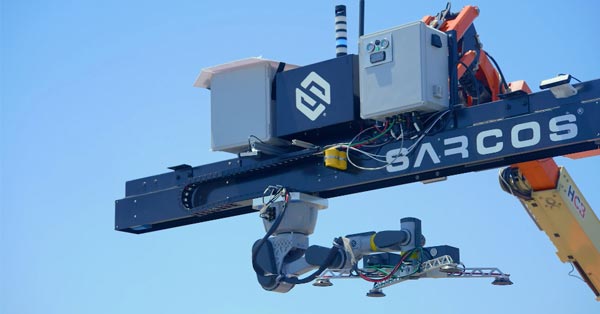
Sarcos, provider of advanced robotic systems and leading installer of renewable energy Blattner Company signed a cooperation agreement to further develop and refine Sarcos’ autonomous robotic solar building system, which is designed for the installation of solar panels in utility-scale solar projects.
Currently, most solar building practices require many time-consuming tasks such as preparing palletized modules, manual installation, and post-installation cleaning. However, Sarcos’ robotic system can deliver, detect, lift and place solar panels on site to help with this Accelerate construction speed, improve installation quality and worker safety and productivity.

Like many other sectors, the solar construction industry is experiencing significant labor shortages in the wake of the COVID crisis, slowing the progress of many U.S. solar initiatives. Sarcos’ autonomous robotic solar construction system “is expected to alleviate these workforce challenges while improving overall safety and speed in the solar installation process,” said Laura Peterson, interim president and CEO of Sarcos.
In fact, the robotic solution comes from Sarcos the prototype developed for the Sarcos Outdoor Autonomous Manipulation of Photovoltaic Panels (O-AMPP) project supported by the US Department of Energy Solar Energy Technologies Office (SETO). The company completed the final validation of the project in Marchand this collaboration with Blattner will focus on further optimizing worker safety and installation efficiency through a series of field trials for which Blattner will provide funding, expertise and testing facilities.
Testing under different environmental conditions at different locations is also seen as a crucial step in preparation for the commercial launch of the system in late 2024.
Much research data suggests that these are utility-scale solar projects an important contributor to increase solar capacity and reduce solar energy prices. The introduction of robotic solutions in this area will strengthen the role of utility-scale solar energy in the energy transition process, while providing valuable data for assessment the potential of automation and personnel development in other projects/segments of the industry.